
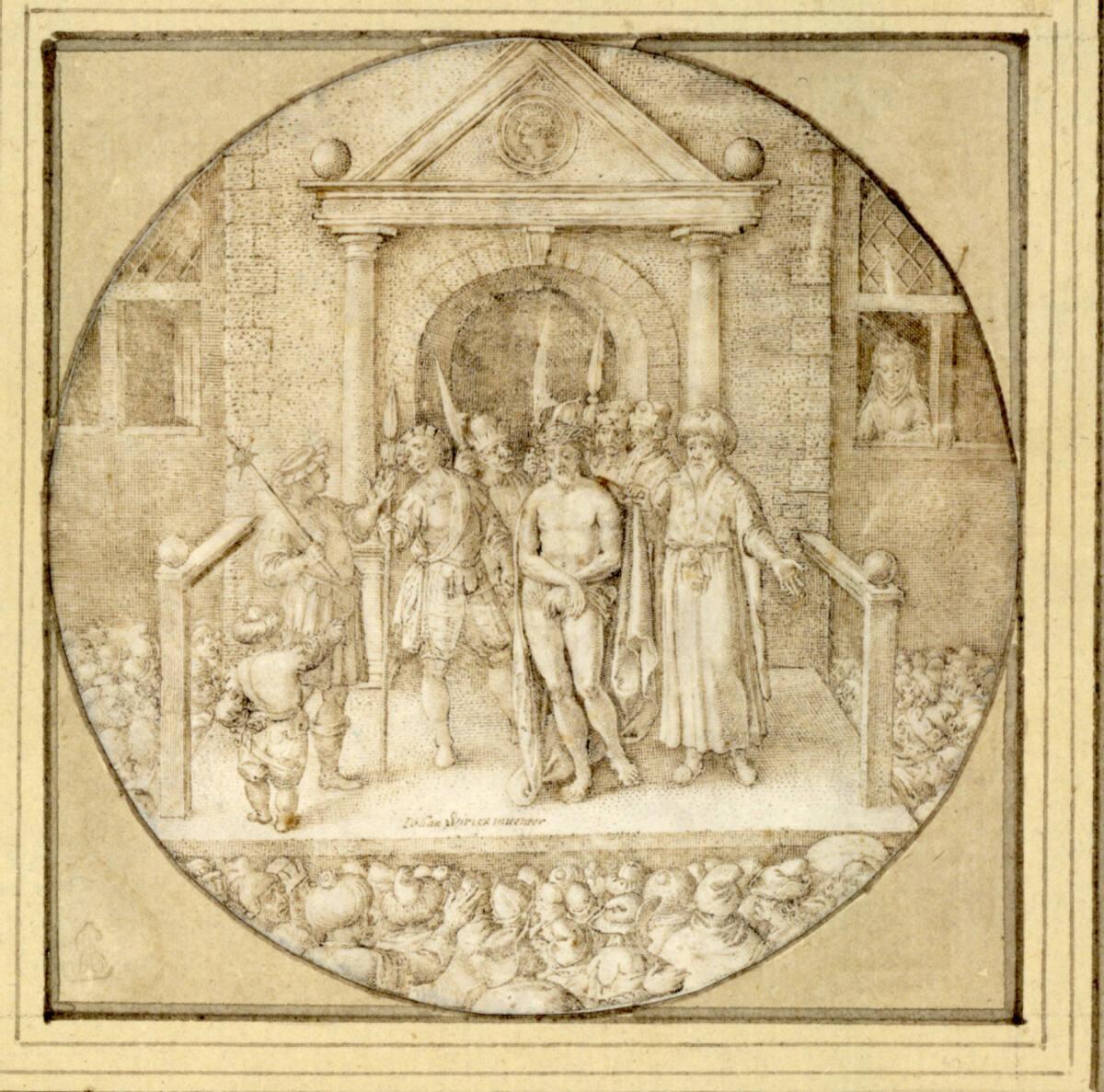

Ecce homo
Jan Wierix
1599
Along with his brothers Hieronymus (1553–1619)
and Antonius II (c. 1555/59–1604), Johannes
Wierix (1549–1620) was one of the most productive
Antwerp engravers of the late sixteenth century. He
was also active as a draftsman, drawing portraits,
history pictures, and religious subjects. The penwerk
(penwork) technique of Wierix’s sheets in this
catalogue is pen and ink drawn on parchment such
that the ink sits atop the smooth surface. Wierix’s
extremely fine marks vary between long but very
thin lines, short flicks, and dots, all optically
coalescing into shapes and shadows from a close
distance (fig. 1). This method of dots and flicks likely
allowed Wierix to work slowly and deliberately in
the fluid medium, starting with light yet relatively
short lines to sketch out the figures, followed by
another round of marks with a wetter pen to fill in
contours and create tonal areas. In this way, the
artist could minimize errors that might result from
longer, wetter contour lines in a medium in which
erasure was nearly impossible. Wierix’s penwerk
drawings reflect some knowledge of manuscript
techniques, but in their status as finished works of
art, they were novel in concept when he began to
make them in the 1570s.1
Five penwerk Passion series by Wierix are known.
The circular Albertina drawings form part of a
series of ten that can be traced to the collection
of Archduke Leopold Wilhelm (1614–1662) and
thereafter to Duke Albert von Sachsen-Teschen
(1738–1822).2 The sheets in the set begin with the
Last Supper and end with the Crucifixion.3 Christ
before Pilate [40] takes place in an interior space in
which the bound Christ stands before the Roman
governor. Seated on a dais, Pilate and other officials
gesture expressively with their hands, and a group
of unruly soldiers flaunt their weapons behind
and beside Christ. In the foreground, a child and
dog frame a block in which Wierix has identified
himself as inventor and maker of the series in 1599.
Christ before the High Priest [41] is staged in a similar
manner, while Pilate Washing His Hands [43], later
in the sequence, features the same room turned on
its axis to face outward toward the viewer. In Ecce
Homo [42], the protagonists appear outside in public
space for Christ’s ultimate condemnation by the
crowd. Wierix’s composition follows the tradition
of Netherlandish and German prints in which
the scene is closely cropped, while Christ’s body,
undraped by his captors, is presented frontally.
Van de Velde describes three versions of series
depicting the Creation and Early History of Man.4
Cleveland’s drawing formed part of what is the
earliest of the known cycles, executed around 1606.
The original group likely consisted of twenty-one
drawings illustrating God creating the heavens
through the Tower of Babel.5 In the dramatic
Expulsion from Paradise [44], a vengeful angel casts
Adam and Eve out of Eden for their transgressions.
Eden is a microcosm populated with an array of
peaceful predators and prey whose tranquility is in
the midst of being undone by human actions. While
the touchstone for the biblical Creation story in the
sixteenth century was Italian fresco painting, such
as works by Masaccio (1401–1428) and Michelangelo
(1475–1564), Northern print series by designers
Maerten de Vos (1532–1603) and Chrispijn van den
Broeck (1530–1590/91) were some of Wierix’s inspiration
here. But the artist’s careful signature on this
and other sheets asserts his independent invention.
Wierix’s penwerk ushered in an increasing
appreciation for drawing among urban audiences.
Evidence suggests that penwerk drawings on parchment
were appreciated by collectors, who prized
them as miniature paintings. One contemporary
inventory of an Antwerp art collection describes a
Wierix penwerk as a “painting done with the pen,”
and another values Wierix’s penwerk Diana and
Actaeon the same as an oil painting by the still-life
and landscape artist Jan Brueghel the Elder (1568–
1625).6 Wierix’s drawings were meant to be viewed
at close range. They were most likely placed in
small art cabinets or domestic spaces in the homes
of the urban middle class and nobility alike. The
inventory of Archduke Leopold Wilhelm indicates
that the Passion series was once framed; two of the
original frames are retained in Vienna.7
1. Nearly ten years his junior, Hendrick Goltzius (1558–1617)
saw Wierix’s works before embarking on his own version of
penwerk, which first appeared in the 1580s (see also [88]);
see Leeflang H. and Luijten 2003, 238.
2. These were in the collection of Archduke Leopold Wilhelm by
the time of the 1659 inventory of the collection, and that of
Duke Albert von Sachsen-Teschen by around 1820; see Berger
1883, 164.
3. The intermediary scenes are: Christ on the Mount of Olives;
The Arrest of Christ; Christ before the High Priest; Christ before
Pilate; The Flagellation; Pilate Washing His Hands; Ecce Homo;
The Carrying of the Cross; The Crucifixion. It is possible
that interceding scenes such as The Mocking of Christ or
The Crowning with Thorns have been lost.
4. Van de Velde 1990.
5. Nine drawings from the series were sold by Katrin Bellinger
in 1993–94 and further dispersed. Another sheet from the
series is at the Metropolitan Museum of Art, New York, 1996.49.
The related series are in the British Museum, London, and were
on the art market with Richard Feigen in 1990.
6. See, for example, Johannes Wierix, Diana and Actaeon,
1599, pen and brown ink, on vellum, 28.7 x 36.7 cm, British
Museum, London, 1946,0713.190. Van Ruyven-Zeman 2004, 237.
See De Schot in Duverger 1984, 7:309.
7. Kunsthistorisches Museum, Vienna, KK5256, KK5331;
the scenes are The Flagellation and The Betrayal;
see Berger 1883, 160.
Emily J. Peters, Laura M. Ritter (Hg.), AK Tales of the City. Drawing in the Netherlands from Bosch to Bruegel, Cleveland Museum of Art 9.10.2022 - 8.1.2023, New Haven 2022, Kat. Nr. 40-43


