
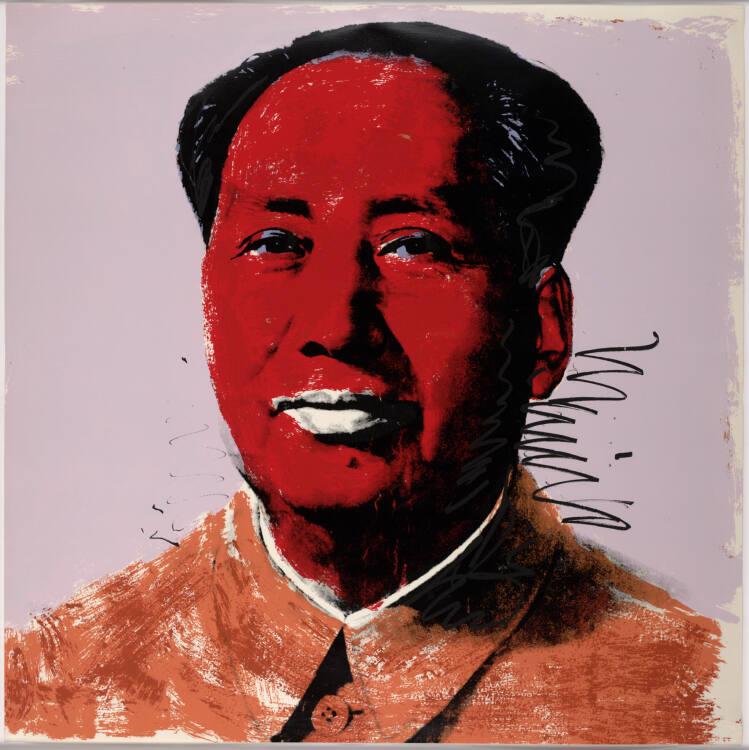
Mao-Tse-Tung
Andy Warhol
1972
In den 1960er-Jahren beginnt Andy Warhol die traditionelle Methode des Farbauftrags mit Pinsel durch die Technik des seriellen Siebdrucks zu ersetzen. Als Vorlagen für seine Druckserien verwendet er dem Publikum vertraute Motive wie die Mona Lisa oder Porträts berühmter Persönlichkeiten wie Marilyn Monroe, Liz Taylor oder Elvis Presley.
Auch seine Auseinandersetzung mit Mao Tse-tung ist als Resultat dieser Begeisterung für Celebrities zu verstehen, bezeichnete doch damals das meinungsbildende Magazin Life Mao als die berühmteste Person der Welt. Warhols Faszination für den „Großen Führer“ führt dazu, dass er 1972 Hunderte Mao-Bilder anfertigt, darunter auch die hier gezeigte 10-teilige Serie. Als Vorlage für seinen Siebdruck bedient er sich einer Fotografie Maos, die auch in dessen Grundsatzbuch „Worte des Vorsitzenden Mao Tsetung“ (auch Mao-Bibel oder Das kleine rote Buch genannt) verwendet wurde. Die Omnipräsenz dieser Fotografie in China während und nach der Kulturrevolution (1966–1976) findet ihre Entsprechung in Warhols serieller Produktion. Typisch für Warhols Porträts der 1970er-Jahre ist die malerische Behandlung der Bilder: Starke Farben sind kraftvoll aufgetragen.
The 1960s saw Andy Warhol replacing the traditional method of applying colour by means of a brush with the technique of serial silk-screen printing. Motifs familiar to the public like the Mona Lisa or portraits of famous persons such as Marilyn Monroe, Liz Taylor, or Elvis Presley provided the models for his series of prints.
Warhol’s engagement with Mao Tse-tung was also a result of his fascination with celebrities: the opinion-forming Life magazine described Mao as the most famous person in the world at the time. Warhol’s enthusiasm for the “Great Leader” made him produce hundreds of Mao pictures in 1972, among them the ten-part series shown here. The model he drew on for his silk-screen print was a photograph of Mao also used in Quotations from Chairman Mao Tse-tung, a book of selected elementary statements likewise known as the Mao Bible or the Little Red Book. The omnipresence of the photograph in China before and after the Cultural Revolution (1966–1976) ties in with Warhol’s serial production. The artist’s portraits of the 1970s are characterized by a painterly treatment of their subjects that relies on vigorously applied bold colours.
Rahmenaußenmaß: 96 x 96 x 4 cm


