
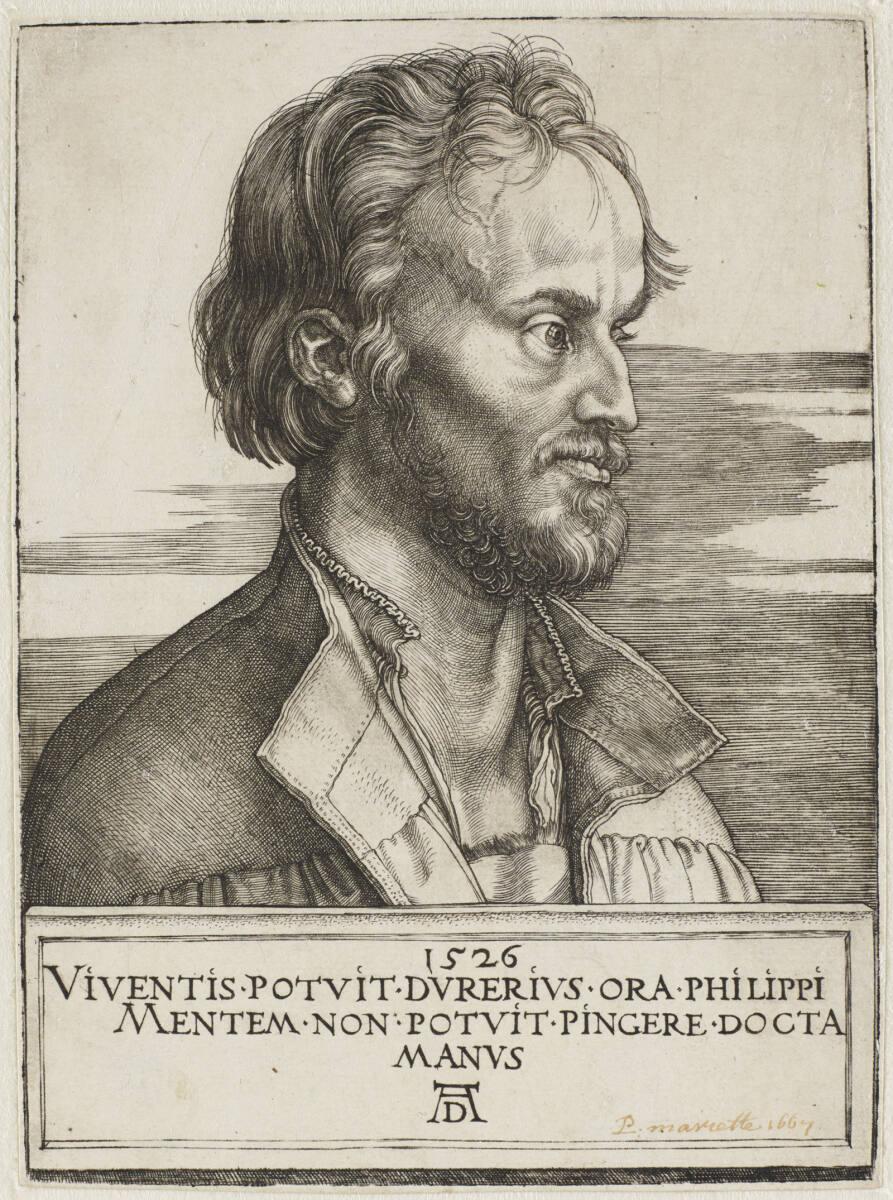

Philipp Melanchthon
Albrecht Dürer
1526
Der Humanist Philipp Melanchthon (eigentlich Philipp Schwartzerdt, 1497–1560) war neben Martin Luther eine der maßgebenden Persönlichkeiten der Reformation. Auf Einladung des Rates von Nürnberg hielt er sich 1525 und 1526 in der Stadt auf, um am Aufbau eines Gymnasiums mitzuwirken. Bei dieser Gelegenheit muss es zu einer Begegnung mit Dürer gekommen sein, bei der eine Porträtzeichnung des Humanisten entstand. Das Kupferstichporträt, das auf dieser Zeichnung basiert, folgt Dürers üblichem Bildnistypus einer Dreiviertelansicht über einer Inschrifttafel und besticht durch den hohen Grad an Realitätsnähe, etwa in der Darstellung der an den Schläfen hervortretenden Adern. Die Inschrift besagt, dass Dürer wohl das Aussehen, jedoch nicht den Geist Melanchthons festzuhalten vermochte.
Along with Martin Luther, the humanist Philip Melanchthon (born Philipp Schwartzerdt, 1497–1560) was one of the decisive figures of the Reformation. At the invitation of Nuremberg’s town council, he came to the city in 1525 and 1626 to participate in the establishment of a secondary school. Dürer probably had the opportunity to draw a portrait of the humanist at that time. The copperplate engraving based on this drawing follows Dürer’s usual pattern of a three-quarter view over a tablet for the inscription. Remarkable is the high degree of realism, as for example in the depiction of the bulging veins at his temple. The inscription states that Dürer could indeed capture the features of the living man but not Melanchthon’s learned intellect.
Einfassungslinie: 17,4 × 12,8 cm


