
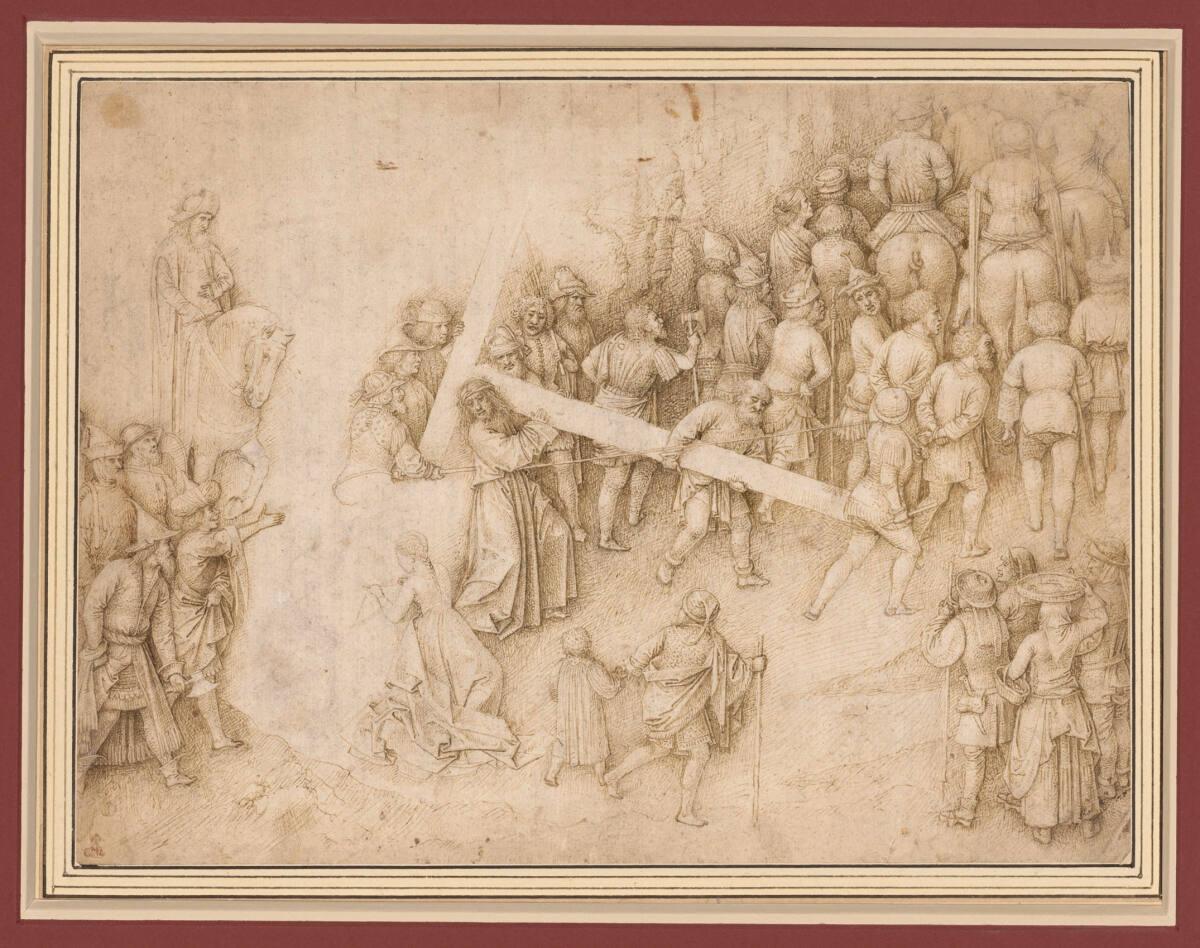

Kreuztragung Christi
Dirk Bouts
um 1460-70
Während sich die meisten niederländischen Zeichnungen des 15. Jahrhunderts auf die Wiedergabe einzelner Figuren beschränken, zeigt dieses außergewöhnliche Blatt eine volkreiche Kreuztragung Christi auf dem Weg nach Golgatha (Mt 27, 31b – 32; Mk 15, 20b – 21; Lk 23, 26 – 32; Jo 19, 16b – 17). Der Figurenzug scheint hinter Christus unterbrochen zu sein, da die Gruppe der Trauernden, denen die kniende Veronika das Abbild Christi auf ihrem Schweißtuch präsentiert, nicht in Feder ausgeführt wurde. Durch dieses Nebeneinander leer gelassener und sorgfältig ausgeführter Partien gibt sich die Zeichnung als Kopie zu erkennen.
Das Kompositionsschema der von Zuschauern gesäumten Wegkurve basiert auf einem verlorenen Vorbild Van Eycks aus der Zeit um 1420 bis 1425, das durch mehrere Kopien überliefert ist. Stilistische Gründe und motivische Übereinstimmungen mit Werken des Dirk Bouts sprechen für eine Entstehung der einst fälschlich Pieter Bruegel d. Ä. zugeschriebenen Zeichnung in seiner Löwener Werkstatt: Figurentypen und Kostümdetails sind Bouts’ Brüsseler Kreuzigung (um 1450 – 1460; Brüssel, Musées Royaux des Beaux-Arts de Belgique, Inv. Nr. 8181, https://www.fine-arts-museum.be/fr/la-collection/dirk-bouts-la-crucifixion?letter=b§) eng verwandt. Der am Kreuzesfuß voranschreitende Scherge findet sich ebenso wie die Figur des Christus in einer Kreuztragung aus dem Atelier von Bouts’ Sohn und Nachfolger Albert (um 1505; Zisterzienserabtei Wettingen-Mehrerau) sowie in der boutsschen Gefangennahme wieder (um 1450 – 1460; München, Bayerische Staatsgemäldesammlungen, Inv. Nr. 990, https://www.sammlung.pinakothek.de/de/artwork/Dn4ZPb3LaK/dieric-bouts-d-ae/tafel-eines-fluegelaltares-gefangennahme-christi§). Die Kreuztragung ist damit ein seltenes Beispiel der bislang wenig bekannten Zeichnungen aus dem Bouts-Kreis, für welche die feine, nuancenreiche Zeichenweise mit filzig verwobenen Schraffen und eingestreuten Punkten charakteristisch ist.
Bosch, Bruegel, Rubens, Rembrandt. Meisterwerke der Albertina, hg. von K. A. Schröder und C. Metzger, Albertina, Wien, Ostfildern 2013, Abb. 15, S. 34.
The approximately six hundred Netherlandish
drawings extant from the fifteenth century are, for
the most part, not sketches, drafts, or autonomous
creations (the latter appeared only in the early
sixteenth century) but, instead, are copies. In
artists’ workshops, such drawings served as training
materials for apprentices, as resources for motifs,
or as replicas of compositions (ricordi). Most of
these copies were limited to the reproduction of
individual figures. In this extraordinary work, however,
we find a composition with many figures. The
drawing depicts Christ bearing the cross on the way
to Golgotha.1 In the center of a procession led by
horsemen, Christ bears a cross with the staff pointed
forward, and Simon of Cyrene helps carry it. One
of the henchmen pulls Christ forward with a rope
bound around his waist while another man walking
behind Christ holds the other end of the rope. Ahead
of Christ, other henchmen and soldiers walk, along
with the two bound robbers who will be crucified
with him. The path, which is lined with onlookers,
curves upward through a ravine, as can be seen
by the outlined crags above and on the right-hand
margin of the image. A richly dressed dignitary
follows on horseback at the end of the procession,
most likely the Roman centurion or Pontius Pilate
himself.
The line of figures behind Christ is interrupted,
since the group of mourners, to whom the kneeling
Veronica presents the image of Christ on her veil,
was not delineated in ink.2 According to the biblical
narrative, Christ encountered Mary and wiped his
face with Veronica’s veil (sudarium) before he was
pulled away by the soldiers. In the drawing, the juxtaposition
of space left empty with carefully executed
sections indicates that it is a copy after another
composition. The original image is lost. A painted
version in Aachen, in which almost all the figures of
the drawing have been reproduced, depicts the crags
that are merely suggested in the Albertina sheet.3
On the left side, the painting offers a landscape view
of a city and mountains in the distance. Conversely,
in the drawing, the public spectacle of the bearing
of the cross lacks any indication of a specific locale.
Due to the minimal foreground, the figural procession
is brought close to the viewer, who assumes the
role of an onlooker on the side of the path.
Most scholars agree that the compositional scheme
is based on a lost model by Jan van Eyck (1390/99–
1441) from between 1420 and 1425, which is known
through several copies. A panel in the Museum of
Fine Arts, Budapest, is regarded as the most faithful
replica of Van Eyck’s original concept (fig. 1). This
work also depicts the curved path through a ravine
with everyday observers and greatly foreshortened
riders seen from behind. Although the broad landscape
with urban scenery plays an important role
in the panel, the draftsman of the Vienna image
concentrated primarily on the figures and chose
another narrative moment with his addition of the
Veronica group. Moreover, in the drawing, the path
runs in the opposite direction to the panel, from left
to right. Other details are also rendered differently,
and the sheet’s figures are more compact and wear
simpler clothing than in the Budapest pendant.4
Thus, while derived from Van Eyck’s composition,
both the drawing and the Aachen painting appear
to document a lost prototype.
There are several reasons for associating the
drawing with Dieric Bouts (c. 1415–1475), who was
active in Leuven. Figural types and costume details
are closely related to Bouts’s Crucifixion in Brussels.5
The advancing henchman at the foot of the cross
can also be found in a Boutsian Betrayal of Christ
in Munich6 and in Bearing of the Cross from the
workshop of Bouts’s son and successor, Albrecht
(1451/55–1549).7 In addition, the fine and richly
nuanced draftsmanship, with interwoven hatching
and interspersed dots, is characteristic of Bouts’s
circle. The numerous parallels suggest that Christ
Bearing the Cross—once erroneously ascribed to
Pieter Bruegel the Elder (1526/27–1569)—was created
in Dieric Bouts’s workshop, where it was frequently
used as a model.
1. Matthew 27:31b–32; Mark 15:20b–21; Luke 23:26–32;
John 19:16b–17.
2. Cf. the reconstructed drawing in Panofsky 1927–28, between
94 and 95, ill. 5.
3. Circle of Dieric Bouts, Christ Bearing the Cross, c. 1490,
oil on panel, 43.5 x 33.8 cm, Suermondt-Museum, Aachen,
GK 58; Grimme 1963, 186–87, no. 99.
4. Cf. a further drawing with several figures from the
procession of riders: Unknown Netherlandish artist, Figures
from Christ Carrying the Cross, c. 1430, silverpoint on green
prepared paper, 13.5 x 11.5 cm, Herzog Anton Ulrich-Museum,
Braunschweig, Z 216.
5. Dieric Bouts, Crucifixion, c. 1450–60, tempera on linen,
181.5 x 153.5 cm, Musées royaux des beaux-arts de Belgique,
Brussels, 8181; Périer-D’Ieteren 2006, 164–65, 237, no. 2.
6. Workshop or follower of Dieric Bouts, Betrayal of Christ,
c. 1478–86, oil on panel, 105.2 x 68.4 cm, Bayerische
Staatsgemäldesammlungen, Alte Pinakothek, Munich, 990;
Périer-D’Ieteren 2006, 192–203, 358, no. A8a.
7. Bearing of the Cross, c. 1505, triptych, oil on panel, left wing,
111 x 62.2 cm, Cistercian abbey of Wettingen-Mehrerau, Bregenz;
Henderiks 2011, 353–54, no. 18.
Emily J. Peters, Laura M. Ritter (Hg.), AK Tales of the City. Drawing in the Netherlands from Bosch to Bruegel, Cleveland Museum of Art 9.10.2022 - 8.1.2023, New Haven 2022, Kat. Nr. 2


