
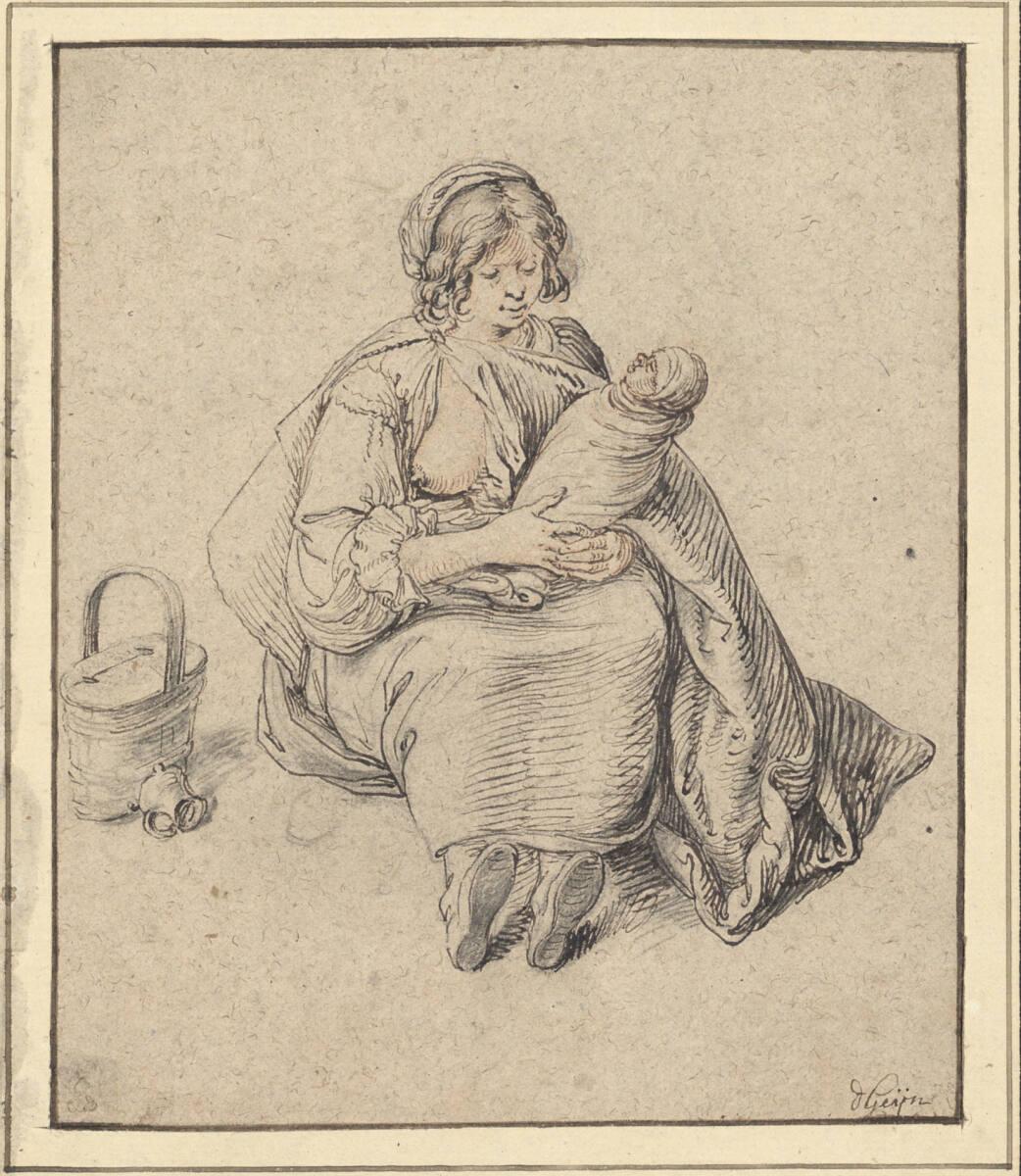

Romni mit ihrem Kind
Jacob de Gheyn (II.)
nach 1600
Zu den vielschichtigen Aspekten der Zeichenkunst von Jacques de Gheyn gehört das Studium "nach dem Leben", das sich in zahllosen wissenschaftlich genauen Darstellungen von Pflanzen und Tieren manifestiert. Eine zentrale Rolle spielt bei ihm die menschliche Figur: Hier reicht das Spektrum von anatomischen Detailstudien, Modellblättern mit Köpfen, einzelnen Körperteilen oder Stellungsvarianten bis zu Szenen des Alltags. Einerseits schloss der Künstler dabei an berühmte Vorgänger wie #Albrecht Dürer oder #Lucas van Leyden an; gleichzeitig entwickelte er die von seinen Vorgängern #Hendrick Goltzius, #Karel van Mander und #Cornelis van Haarlem eingeführte Praxis des Zeichnens nach dem lebenden Modell höchst eigenständig weiter.
De Gheyns Interesse für die Lebensgewohnheiten und das äußere Erscheinungsbild der Roma, die 1595 per Edikt aus dem städtischen Leben verbannt und dadurch zu einer gesellschaftlichen Randexistenz gezwungen worden waren, geht aus einer Anzahl von gezeichneten Darstellungen hervor. Zu diesen zählt auch das ausgestellte Blatt mit einer am Boden sitzenden Frau mit ihrem Kind, die vor allem aufgrund ihres Umhangs und ihrer Kopfbedeckung als Romni identifiziert werden konnte.
Das Neuartige an dieser Arbeit ist, dass hier nicht nur die einfachen, realistischen Einzelheiten – bis hin zum detailliert dargestellten Korb – genau registriert wurden. Die lebensnahe Szene, in der sich die Mutter zärtlich ihrem Kind zuwendet, ist zudem von einem besonderen Ausdruck der Intimität bestimmt. Mit großer Sicherheit definierte der Künstler die Umrisse der Figur; im Innenbereich wechseln lang gezogene, parallele Schlingen und Zickzacklinien in unterschiedlicher Dichte einander ab. Die frei gelassenen Papierstellen verweisen auf die Wirkung des Lichts, während die schwersten Schattenpartien sich in den Falten des am Boden ausgebreiteten Umhangs bilden. In seinen Federzeichnungen verbindet der Künstler die im 16. Jahrhundert wurzelnde Kalligrafie mit einer Unmittelbarkeit der Beobachtung und des Ausdrucks, die auf kommende Entwicklungen vorausweist. Auf unverwechselbare Weise vertritt Jacques de Gheyn um 1600 den Übergang vom Manierismus zum neuen Realismus.
aktualisierter Text aus: Das Zeitalter Rembrandts, Ausstellungskatalog, hg. von K. A. Schröder und M. Bisanz-Prakken, Albertina, Wien, Ostfildern 2009, Abb. 28, S. 72.
Jacques de Gheyn II’s (1565–1629) drawings of the
human form range from anatomy and head studies
and renderings of individual body parts or poses to
scenes of everyday life and include some of the first
nudes drawn naar het leven (from the life) in the
Netherlands. De Gheyn’s approach to the human
figure was informed by famous predecessors
such as Albrecht Dürer (1471–1528) and Lucas
van Leyden (1494–1533), as well as the Mannerist
tendencies of his direct contemporaries Hendrick
Goltzius (1558–1617) and Karel van Mander
(1548–1606). Like these artists, he relied on drawing
for many aspects of the planning of his works, but
he also made scores of sketches with no other purpose
beyond observation from nature. While many
of his observational figure studies depict models or
family members in his studio or home, a handful of
sketches portray individuals in public spaces such
as the streets or markets of the city. This drawing
of a seated woman who pauses from nursing her
newborn is one such study.
Very likely, the sheet depicts a Roma woman.
De Gheyn’s interest in the customs and appearance
of the Roma, whose presence in the Netherlands is
attested by an edict from 1595 banishing them from
urban life, is indicated by a number of drawings
of Romani individuals.2 The similarities of media,
paper, and subject of drawings by De Gheyn in
Boston, Chicago, and Oxford indicate that they
were all executed around the same time, between
1600 and 1605 (fig. 1).3 In the Albertina sheet, the
woman is seated on the ground with knees raised
and her cape pushed to the side to expose her
breast, while momentarily holding the swaddled
infant away from her. De Gheyn introduces prosaic
elements, such as the basket and the toppled teacup
beside her, as well as the expression of tenderness
between mother and child. The straightforward
observational study reveals De Gheyn’s desire to
see and record the Romani for himself, as if to avoid
the iconographic tradition in which the Roma were
cast in the roles of pickpockets, necromancers, or
fortune-tellers. Nevertheless, his Roma drawings
did eventually inform one such image: his own
Fortune-Teller engraving of around 1608 (fig. 2).4 The
seated female figure at the right of the engraving is
related to the Boston sketch and could represent the
same model as that in the Albertina sheet.
De Gheyn’s signature technique of drawing in
bold, swirling patterns of pen-and-ink lines creates
volume, shadow, and light. He varied the width
and weight of his lines, much as he would do when
making engraved lines in a copperplate with a
burin, in order to create deeper shadows or brighter
highlights. He drew over preliminary sketches in
black chalk, which is still discernible around the
knees, the hair, the shoes, the edges of the cloak,
and the basket. Black chalk would have been more
convenient for a preliminary study from life and
appears, as well, in the drawings in Boston, Chicago,
and Oxford. Such exacting studies of ordinary people
herald the advance of genre subject matter and
naturalism at the dawn of the seventeenth century.
1. Red chalk probably added by a later hand.
2. Van Regteren Altena 1983, 2:87–89, nos. 534–39; on this theme,
see also 1:89.
3. For the Boston drawing, see fig. 1; Two Studies of a Roma
Woman and a Roma Boy in a Large Hat, c. 1605, pen and ink,
on tan paper, 23 x 26 cm, Art Institute of Chicago, 1959.2;
Seated Figures of a Woman and Child, c. 1600–1605, pen and
ink, on tan paper, 18.6 x 15.8 cm, Ashmolean Museum, Oxford,
WA1863.170; Robinson F. and Schatborn 1991, 38.
4. Filedt Kok and Leesberg (NHD) 2000, 154.
Emily J. Peters, Laura M. Ritter (Hg.), AK Tales of the City. Drawing in the Netherlands from Bosch to Bruegel, Cleveland Museum of Art 9.10.2022 - 8.1.2023, New Haven 2022, Kat. Nr. 60


