
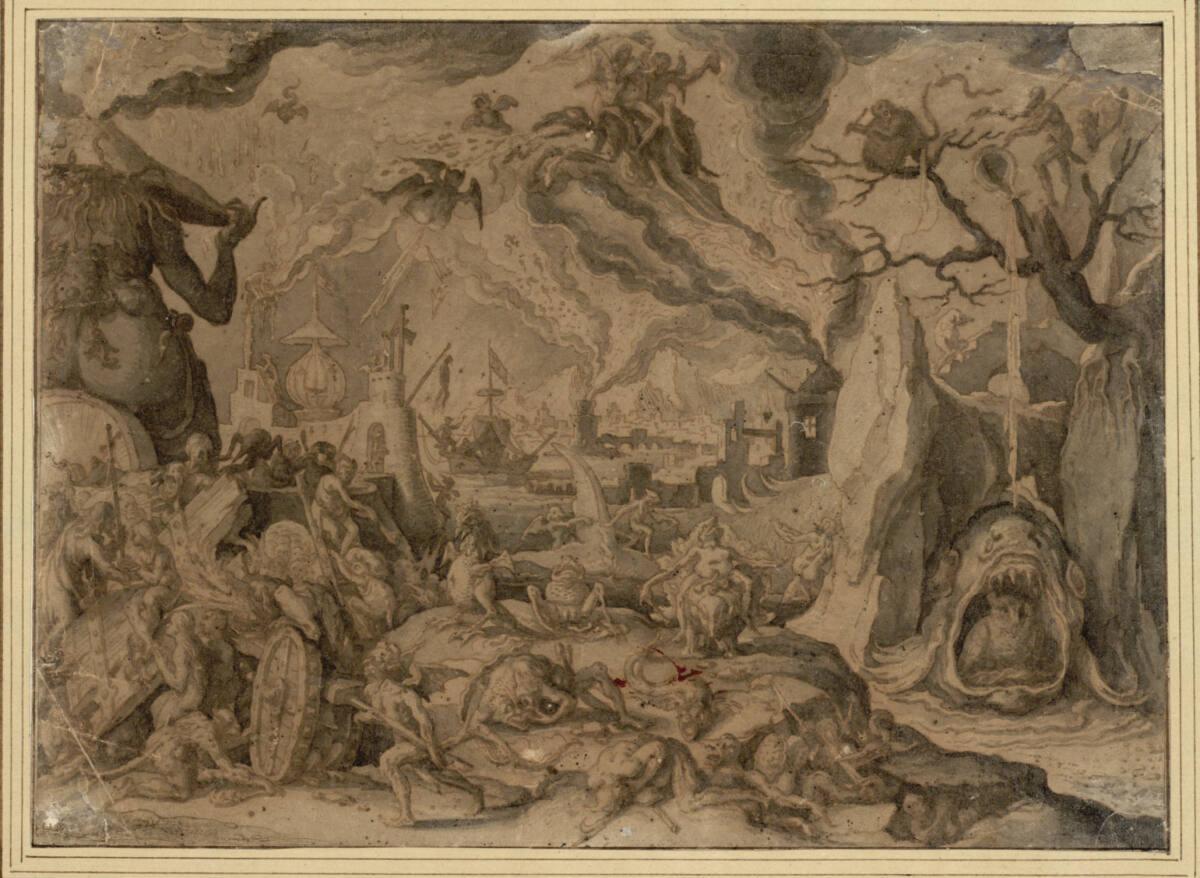

Christus in der Vorhölle
Jacob de Gheyn (II.)
um 1600
The story of Christ in Limbo has its origins in the
Gospel of Nicodemus, which was likely written in
the fourth century and was well-known in the early
modern Netherlands. According to this apocryphal
text, the Savior travelled down into the underworld
on the third day after his Crucifixion to liberate the
righteous of the Old Testament. Those figures in the
biblical narrative who had died prior to the death of
Christ—his ancestors, the patriarchs and prophets of
the Old Covenant—had all been in Limbo from the
time of their death up until their anticipated entry
into the Kingdom of Heaven. Originally envisioned
as a neutral realm, Limbo was reinterpreted during
the High Middle Ages as an antechamber of Hell,
now pictured as an infernal domain.
Accordingly, Jacques de Gheyn II (1565–1629)
visualized this episode amid a rugged, demonic
landscape with bodies of water, architectural
ruins, and an overcast sky dark with clouds and
swathes of smoke. Only after a second glance can
one discern the figure of Christ at the left edge of
the image: with his cross-staff and victory flag, he
seems to have broken open the heavy doors to the
land of the dead in order to lead the naked souls of
the Old Testament toward the light. Much of the
depiction is dominated by monstrous, composite
creatures engaged in a wide range of activities that
the artist conceived with an extraordinary graphic
imagination.
The tendency to render the netherworld as a landscape
began with Jheronimus Bosch (c. 1450–1516),
an artist working in Brabant almost one hundred
years before De Gheyn. Until the turn of the
sixteenth century, Hell and Limbo had generally
been represented as enormous animal mouths that
did not permit a differentiated spatial configuration
of these realms. Such a gaping mouth of Hell is
integrated as a motivic detail into the Albertina
drawing: on the right, within the wide-open jaws of
this fishlike monstrosity, an owl, symbol of darkness
and evil, has found its natural habitat.
Until the early nineteenth century, this sheet was
ascribed to Pieter Bruegel the Elder (1526/27–1569).1
After Benesch reattributed it to Karel van Mander
(1548–1606), roughly a decade later, on the basis
of stylistic observations,2 Van Regteren Altena
recognized the drawing as the work of De Gheyn.3
Imagery of the fantastic and the grotesque assumed
a central role in the oeuvre of this Antwerp-born
master, who probably immigrated to the Northern
Netherlands prior to 1585. In particular, De Gheyn’s
portrayals of witches and their supernatural activities
enjoyed great popularity in bourgeois society, as
evidenced by their frequent reproduction in print.4
In contrast to Bosch’s renderings, with their scatological
critique of a sinful world, by the turn of the
seventeenth century absurd creatures and bizarre
landscapes were increasingly prompted by a desire
for horrors. Analogous to his meticulous observational
studies, De Gheyn prepared his diabolical
depictions in the form of drawings as if from nature.
In works such as Studies of Attributes and Creatures
of Witchcraft, in Paris,5 he developed an array of
toad-like monsters—wildly contorted and endowed
with human sexual characteristics—which, only on
closer viewing, prove to be imaginary hybrids.
A precise date for Christ in Limbo has not been
given; Van Regteren Altena aligns the work chronologically
with a technically and stylistically related
drawing in Orléans6 that he dates to 1595–1600.7
Also, the sketch for a Witches’ Sabbath, in Stuttgart,
made about 1605, is closely connected in motif to
the Vienna drawing, thereby suggesting a date
around the turn of the century.8 A painting that
matches the Albertina sheet in composition but
differs in several details was offered for sale in
Cologne in 1913.9 Still incorrectly identified as the
work of “Pieter Brueghel (Höllenbreughel”)10 in the
auction catalogue, the panel reveals obvious artistic
flaws when compared to the sheet.11 It was probably
painted after the drawing by one of the artists
associated with De Gheyn in Leiden, where the
master was active until around 1600.
1. For a drawing of Limbo by Bruegel, see [76].
2. Benesch O. 1928, 36.
3. Van Regteren Altena 1936, 33n4.
4. For examples, see Filedt Kok and Leesberg (NHD) 2000;
Swan 2005.
5. Jacques de Gheyn II, Studies of Attributes and Creatures
of Witchcraft, c. 1600–1610, pen and brown ink, black chalk,
on paper, 94 x 35.3 cm, Fondation Custodia, Paris, Frits Lugt
Collection, 6863.
6. Jacques de Gheyn II, Cove with Rugged Coastline, 1595–1600,
pen and brush and brown and gray inks, on paper, 12.8 x 19.1 cm,
Musée des Beaux-Arts, Orléans, 1238.
7. Van Regteren Altena 1983, 2:148, no. 965.
8. Jacques de Gheyn II, Witches’ Sabbath, c. 1605, pen and
brush and brown and gray inks, wash, on paper, 45 x 68.2 cm,
Staatsgalerie, Stuttgart, C 1095.
9. Van Regteren Altena 1983, 2:29–30, no. 59.
10. Heberle 1913, 6, no. 7.
11. The anatomically unconvincing figure of Christ, with an
unnaturally short neck and awkwardly elevated shoulders, has
lost its dynamic movement in comparison with the drawing. In
addition, De Gheyn’s demonic creatures, such as the monsters
creeping out of a rock crevice in the right foreground, which
had been organically integrated into the landscape, are evenly
distributed over the surface of the painting, like props.
Emily J. Peters, Laura M. Ritter (Hg.), AK Tales of the City. Drawing in the Netherlands from Bosch to Bruegel, Cleveland Museum of Art 9.10.2022 - 8.1.2023, New Haven 2022, Kat. Nr. 77
 IIIFPermalinkhttps://sammlungenonline.albertina.at/objects/28750/christus-in-der-vorholleImage Request


