
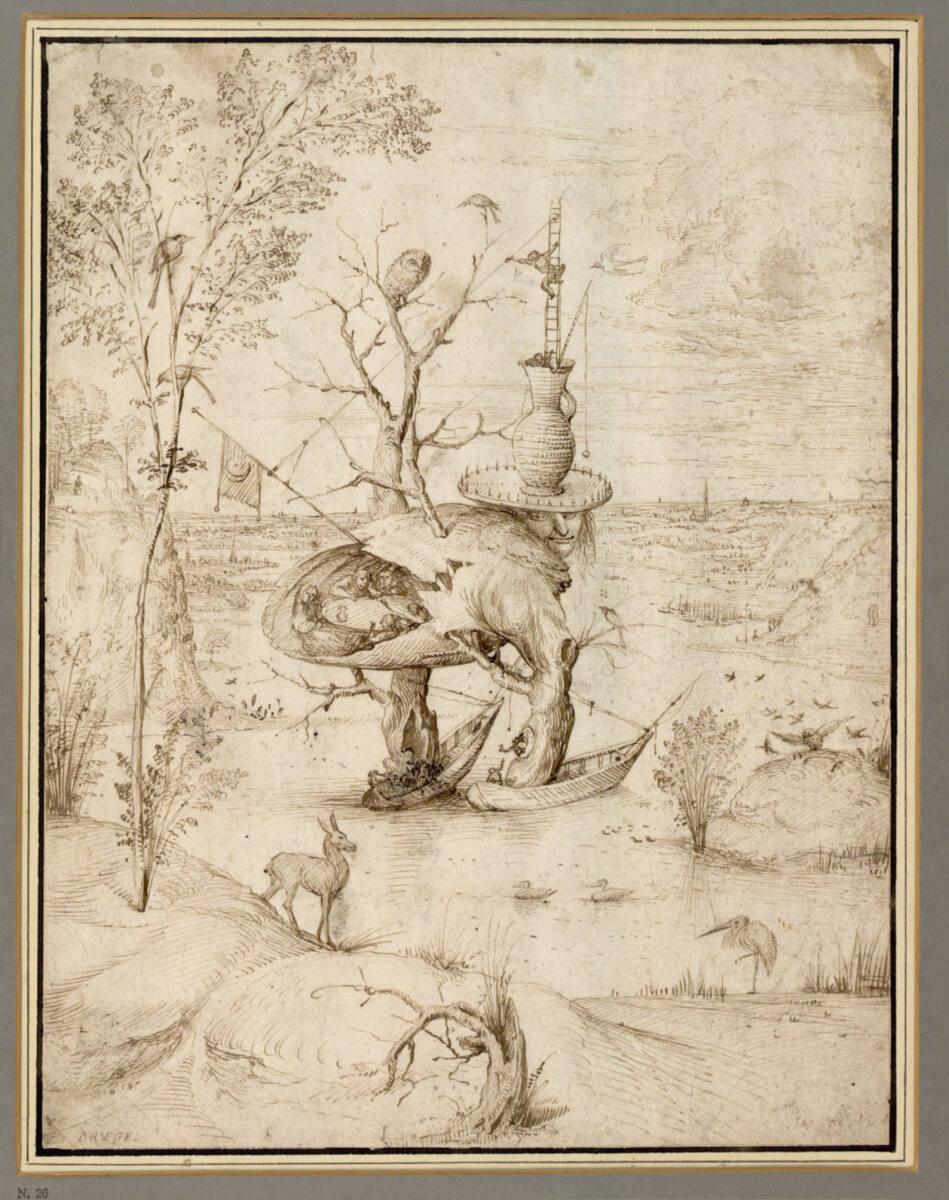

Der Baummensch
Hieronymus Bosch
um 1500
Rahmenaußenmaß 49,7 × 42,3 × 4,4 cm
Die mangelnde Information über Leben und Werk von Hieronymus Bosch steht zu seinem legendären Bekanntheitsgrad in krassem Widerspruch. Man kennt weder das Datum noch den Ort seiner Geburt; auch über seine Ausbildung ist nichts bekannt. Seit 1486 war er Mitglied der Liebfrauen-Bruderschaft in 's-Hertogenbosch. In dieser Stadt wurde er 1516 beigesetzt. Seine Werke sind weder datiert noch urkundlich gesichert; die Signaturen der Gemälde sind zweifelhaft. Heute gelten nur mehr etwa 25 Tafelbilder und Triptychen als eigenhändig. Noch geringer ist die Anzahl der Zeichnungen: Nicht mehr als zehn Arbeiten auf Papier können ihm heute mit Sicherheit zugeschrieben werden.
Unter diesen seltenen Werken gilt "Der Baummensch" aufgrund des bildmäßig vollständigen Charakters als einmaliges Beispiel. In dieser Zeichnung hat Hieronymus Bosch das Motiv des Baummenschen aus der Darstellung der Hölle im rechten Altarflügel des Triptychons "Garten der Lüste" (Madrid, Museo Nacional del Prado, Número de catálogo P002823 https://www.museodelprado.es/coleccion/obra-de-arte/triptico-del-jardin-de-las-delicias/02388242-6d6a-4e9e-a992-e1311eab3609?searchid=01fc70ca-1926-48da-2e3e-0f0515457047§) abgewandelt. An die Stelle des höllischen Ambientes der gemalten Fassung tritt hier als wichtigste Änderung eine von Tieren, Schiffen und weit entfernten Häusern belebte Weltlandschaft.
Das monströse Fantasiewesen, teils Mensch, teils Baum, trotzt allen Regeln der Vernunft und des Wissens. Seine Beine sind zwei Baumstämme, die auf wackeligen Kähnen dahintreiben. Knorrige Äste durchstoßen den hohlen, eiförmigen Leib, dessen aufgebrochenes Hinterteil das Innere preisgibt: eine zechende Tischgesellschaft, durch die Bosch die Leere des nutzlosen, zu Tod und Verdammnis führenden Lebens anprangert. Das einzige menschliche Element des Ungetüms ist das seitwärts gedrehte Gesicht eines Mannes. Sein Blick in die Richtung der zechenden Runde ruft, im Sinne der zeitgenössischen moralisierenden Literatur, zur Selbsterkenntnis auf.
Der Trinkkrug auf der Kopfbedeckung des Mannes ist ebenso mit negativer Symbolik beladen wie der Dudelsack, der sich in der gemalten Fassung an der gleichen Stelle befindet. Die Eule symbolisiert als Nachtvogel die dunkle Seite des Menschen, im Gegensatz zu den anderen Vögeln der Zeichnung, die untertags aktiv sind; auf die sinistere Nacht verweist auch der Mond auf der Fahne.
In "Der Baummensch" zieht Bosch alle Register seines einmaligen zeichnerischen Könnens, von den kräftig charakterisierenden Federlinien des zentralen Motivs bis zu den feinsten Strichelungen am Horizont der friedlichen Weltlandschaft, in der sich das skurrile Ungeheuer wie ein Fremdkörper ausnimmt.
Marian Bisanz-Prakken, in: Klaus Albrecht Schröder (Hg.), Die großen Meister der Albertina (Kat. Best. Albertina, Wien 2008), Petersberg 2008, Nr. 23.
This sheet represents one of the earliest preserved
autonomous drawings in Netherlandish art. Created
around 1500 by Jheronimus Bosch (c. 1450–1516) of
the Brabant city of ’s-Hertogenbosch, it was most
likely not intended for workshop use and possessed
no direct function as a study, copy, or pattern
sheet. Scholars have repeatedly assumed that the
drawing was made as a later memento of the related
creature from the “Hell” wing in Bosch’s celebrated
triptych, The Garden of Earthly Delights.1 As Koerner
suggests, the work could have been a commission
from an enthusiast who had seen the painting and
then requested a ricordo on paper from the artist.2
After all, the sheet was executed at precisely the
moment when drawings were gaining increasing
importance in the Netherlands both as valued
collectibles and examples of an artist’s technical
and imaginative accomplishment.
At the same time, the drawn version of
The Tree Man differs from the painting not only in
numerous details but also in its placement in an
ideal “world landscape.” Beyond the terrain in the
foreground, a broad panorama opens out. Several
hills, with trees and animals, direct the viewer’s
gaze down the course of a river to the distant city in
the background. The eponymous giant rises up in
the center of the picture. Half-human and half-tree,
it appears to float on the water in two small barks.
Its fragmented trunk is perforated in several spots
by the outgrowths of its vegetal forms. A carousing
company of tiny figures occupies the creature’s
stagelike, open interior. Their wantonness and gluttony
are a moralizing comment on the vices of intemperance
and self-indulgence. Wholly immersed
in itself, the monster turns its face, framed by long,
thin hair, back toward its body. The half-moon flag
hoisted to the left is an insignia of the Orient and
its dreaded “heresy,” and references the imminent
danger of an Ottoman invasion.
Along with such motivic oddities, the sheet is
striking in its paradoxical realism. Despite the
actual impossibility of what is depicted, the artist
endows the Tree Man with a great deal of plausibility
through graphic artifice: clearly indicated
shadows and perspectival foreshortening locate the
creature in space, while the slight tipping of the
boats lends it heft, and the apparently organic convergence
of artificial and natural elements creates
visual consistency. The irritation of the viewer on
both thematic and formal levels is typical of Bosch’s
works and produces an air of the uncanny, inviting
careful observation and active reflection on what
we see.
Bosch’s assured, rapid penwork, which betrays
no corrections, and the dynamic, mostly parallel
hatching can also be observed in the master’s two
other pictorially finished drawings that have been
preserved.3 These qualities solidly anchor the
Albertina sheet at the center of Bosch’s graphic oeuvre.
The inscription BRVEGEL, which was probably
added in the late sixteenth century, documents
the erroneous identification of the artist as Pieter
Bruegel the Elder (1526/27–1569), a long-established
misattribution that persisted until the 1920s.4
However, it also attests to the tremendous success
of Bosch’s pictorial inventions, which Bruegel and
numerous others studied and adapted for new
artistic contexts throughout the sixteenth century
(see Ritter’s essay and [73–76]).
1. Jheronimus Bosch, The Garden of Earthly Delights, c. 1500, oil
on panel, 185.8 x 172.5 cm (central panel), 185.8 x 76.5 cm (wings),
Museo Nacional del Prado, Madrid, P002823.
2. Koerner 2004a, 380n45.
3. See Jheronimus Bosch, The Owl’s Nest, c. 1500, ink on paper,
14.1 x 19.7 cm, Museum Boijmans Van Beuningen, Rotterdam,
N 175; Jheronimus Bosch, The Hearing Forest and the Seeing
Field, c. 1505, ink on paper, 20.2 x 12.7 cm, Kupferstichkabinett,
Staatliche Museen, Berlin, KdZ 549. The comparison was first
made in Benesch O. 1928, 5, no. 26.
4. The “dessin bizarre grotesque de la figure d’un homme
formé de deux arbres tortueux” (bizarre, grotesque drawing of
the figure of a man formed of two crooked trees) also entered
the collection of Duke Albert von Sachsen-Teschen as a work
by Bruegel. The Albertina Museum, Vienna, Archive of the
Collection, Cahier, 7876. It was Friedländer who first attributed
the drawing to Bosch; see Friedländer 1924–37, 5:124–25.
Emily J. Peters, Laura M. Ritter (Hg.), AK Tales of the City. Drawing in the Netherlands from Bosch to Bruegel, Cleveland Museum of Art 9.10.2022 - 8.1.2023, New Haven 2022, Kat. Nr. 4


