
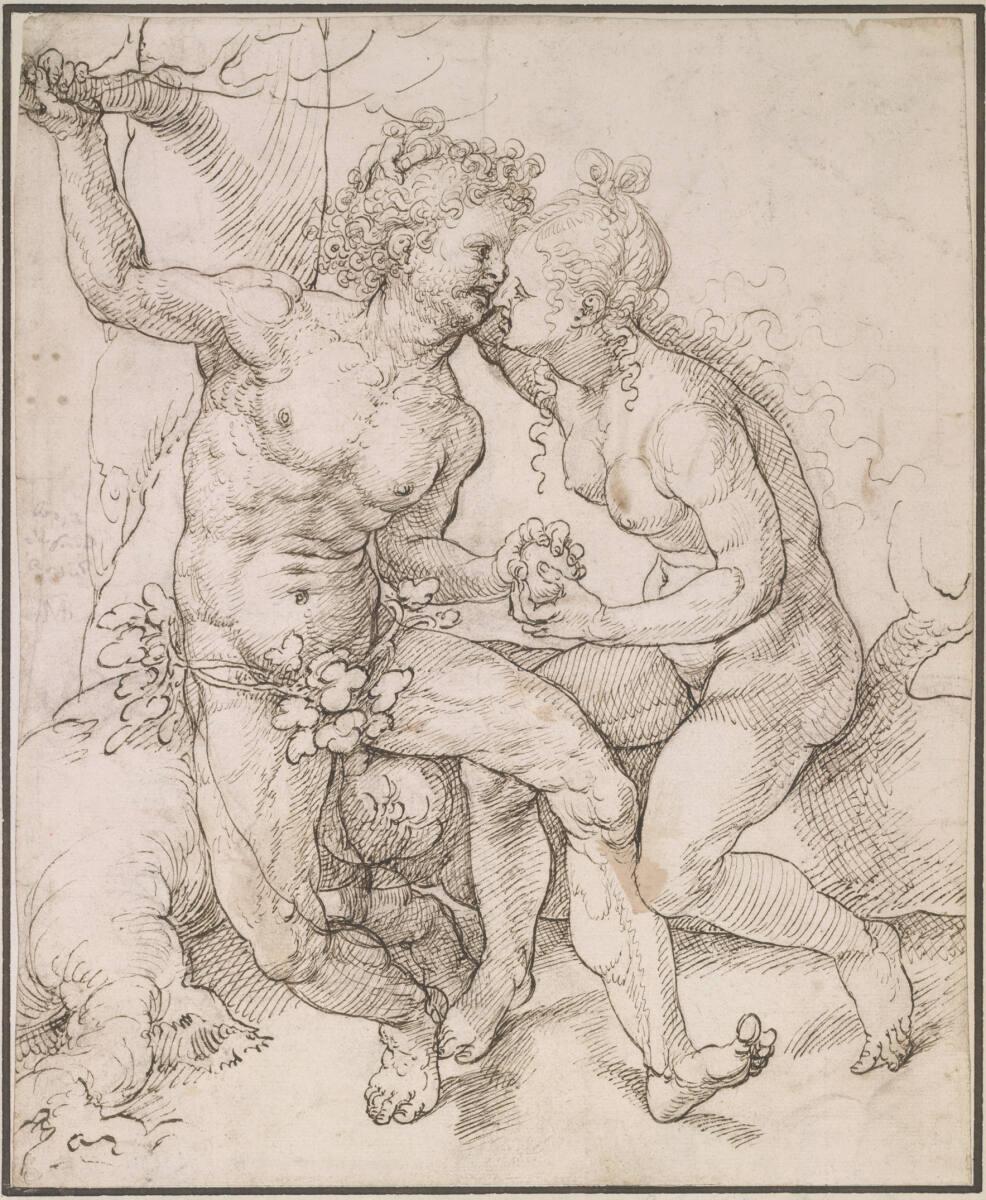

Der Sündenfall
Jan Gossaert
um 1520-1525
The Old Testament story of the fall of Adam and
Eve1 tells how the first pair of human beings violated
God’s only prohibition in paradise: eating the fruit
from the tree of the knowledge of good and evil.
The tale is paradigmatic for the timeless relevance
of issues surrounding guilt; seduction; the essence
of evil; human sexuality, self-determination, and
knowledge; and the grave punishment of such intentions.
In traditional Christian iconography, it was the
source of original sin, which necessitated Christ’s
redemption.
Jan Gossart (1478–1532) dealt with the subject of
the fall in several paintings and drawings,2 chiefly
focusing on the figures’ relationship to one another
and their physical and compositional interaction.
In his first painted version of the theme, executed
around 1510, Gossart chose a conventional solution,3
in which Adam and Eve as idealized figures stand
beside one another without touching or overlapping.
This work was largely inspired by Albrecht Dürer’s
(1471–1528) famous engraving of 1504 (fig. 1).
In Gossart’s later versions, however, the figures
interact and tightly embrace: an affective interplay
that represents a completely novel approach to the
subject in early sixteenth-century Netherlandish
art.4 In the present drawing the pair is depicted unusually,
sitting under the tree of knowledge rather
than standing.5 The nude couple leans in to kiss.
Eve holds the back of Adam’s head with her hand
while he, still somewhat reluctant, holds onto a
tree branch.6 There is no longer a seductive serpent
persuading her to act; instead, Adam and Eve both
actively clasp the plucked fruit in their hands. Their
bodies additionally frame and highlight the fruit in
the center of the drawing, while their legs, intimately
crossed, suggest their erotic (and sinful) union.7
The many depictions of nudes in Gossart’s oeuvre
attest to his knowledge of ancient Roman and
Italian art. He was able to study both in 1508–9
during a journey to Rome as part of the entourage
of Philip of Burgundy (1464–1524), an illegitimate
son of Duke Philip the Good (1396–1467). Gossart’s
drawings of ancient architecture and sculpture,
which were commissioned by Philip of Burgundy,
are the earliest surviving examples of this type by
a Netherlandish artist. They were also foundational
for his later work. Adam’s upper body, which is
leaning slightly forward and turned, mirrors the
famous Belvedere Torso (first century BC),8 which
Gossart may have seen in in Rome.9
We can trace Gossart’s effort to better balance
the figure of Adam through his correction of
the right leg, which is drawn twice. Adam’s right
hand (erroneously drawn as a second left hand)10
and the ambiguous space surrounding the tree’s
roots and trunk, upon which the couple sits, seem
incongruous. Furthermore, the loose hatching with
which the figures and the tree are modeled differs
substantially from the fine networks of lines in
Gossart’s earlier drawings. For this reason, The Fall
is assigned to around 1520–25.
Both Adam and Eve reach for the fruit with
their left hands instead of their right. Thus, it has
been repeatedly assumed that the present sheet
was a model for a woodcut, which would then be
cut by a professional form cutter.11 However, no
such woodcut is known. Scholars have considered
The Fall a potential pendant to Gossart’s Cain and
Abel.12 Yet the drawing could just as easily have fit
into a cycle on the theme of the “power of women.”13
Dürer’s graphic works, which were disseminated in
the Netherlands after his journey there in 1520–21,
may also have provided the impulse for Gossart’s
endeavors in this medium, undertaken to reach a
broader, urban public.
1. Genesis 3:1–6.
2. Cf. Ainsworth et al. 2010, 114–22, nos. 1–3 (paintings), 308–14,
nos. 64–66 (drawings), 314–18, nos. 67–68 (copies after Gossart).
3. Jan Gossart, Adam and Eve, c. 1510, oil on oak panel, 56.5 x
37 cm, Museo Thyssen-Bornemisza, Madrid, 1930-26;
Ainsworth et al. 2010, 114–17, no. 1. For the engraving, see
Schoch et al. 2002, 110–13, no. 39.
4. In 1953, Schwarz mentioned woodcuts by Hans Baldung Grien
(1484/85–1545) as possible models; cf. Alsteens 2010, 92;
Alsteens in Ainsworth et al. 2010, 308–10, no. 64.
5. An early example of the relatively rare type of the seated
Adam and Eve is Lucas van Leyden, The Fall of Man, c. 1505,
copper engraving, 11.8 x 8.8 cm, The Albertina Museum,
Vienna, DG1926/1896.
6. Mensger points out the typical schema of the power of
women—the dominant woman and the man who is at her
mercy—as well as Gossart’s interpretation of the fall as a
sexual act; Mensger 2017, 194–95, no. 82.
7. The motif of interlocking legs is also found in other couples
in Gossart’s works, such as Hercules and Deianira, 1517,
oil on oak panel, 36.8 x 26.8 cm, The Barber Institute of Fine
Arts, University of Birmingham, 46.10; Ainsworth et al. 2010,
221–24, no. 31; and Hermaphroditus and Salmacis, c. 1517, oil on
oak panel, 32.8 x 21.5 cm, Museum Boijmans Van Beuningen,
Rotterdam, 2451; Ainsworth et al. 2010, 224–26, no. 32.
8. Today in the collection of the Museo Pio-Clementino,
Vatican Museums, Vatican City, 1192.
9. Cf. Gossart’s Christ on the Cold Stone, c. 1530, oil on panel, 112 x
84 cm, Real Colegio del Corpus Christi, Valencia, 94; Ainsworth
et al. 2010, 210–13, no. 28 (with reference to Marcantonio
Raimondi’s [c. 1470/82–1527/34] 1508 engraving Mars, Venus,
and Eros). The Belvedere Torso was formerly in the exquisite
antiques collection of the sculptor Andrea Bregno (1418–1503).
According to Haskell and Penny 1981, 311–12, it stood from 1506
at the Palazzo Belvedere. It entered the Vatican collections
between 1530 and 1536.
10. Ainsworth in Ainsworth et al. 2010, 205, under no. 26
(Christ Bearing the Cross, private collection).
11. Cf. Ainsworth et al. 2010, 310–12, no. 65, 311–12n4, with
prior literature. For Gossart’s graphic works in general,
see Orenstein 2010.
12. Hollstein and Schuckman (HD) 1949, 8:148, no. 4. Unknown
Netherlandish artist after Jan Gossart, Cain Kills Abel, c. 1525,
woodcut, 30.5 x 22.4 cm, The Albertina Museum, Vienna, DG
1949/641; see also Ainsworth et al. 2010, 418–21, no. 117.
13. It is worth recalling Lucas van Leyden’s (1494–1533)
two great series on the power of women (c. 1514, c. 1517–19);
see Wagini 2017, 123–26, no. 31.1
Emily J. Peters, Laura M. Ritter (Hg.), AK Tales of the City. Drawing in the Netherlands from Bosch to Bruegel, Cleveland Museum of Art 9.10.2022 - 8.1.2023, New Haven 2022, Kat. Nr. 69
Der Sündenfall von Adam und Eva (Gen 3, 1 – 6) beschäftigte Jan Gossaert in zahlreichen Gemälden und Zeichnungen. Bei der vorliegenden Version sitzt das Paar unter dem verbotenen »Baum der Erkenntnis« und ist einander, mit der bereits gepflückten Frucht in den Händen, zum Kuss zugeneigt. Gossaert interessierten bei seiner Umsetzung des biblischen Themas vor allem die Anatomie der nackten Körper – das rechte Bein Adams war ursprünglich anders positioniert und erscheint daher verdoppelt – und die kompositionelle Verschränkung der beiden Figuren, wobei er auf Vorlagen italienischer Künstler sowie auf Holzschnitte Hans Baldung Griens zurückgriff.
Die ausdrucksvolle Zeichnung entstand um 1520 bis 1525 und ist von besonderer Bedeutung, da sie als sicher eigenhändige, reife Arbeit als Parameter für weitere Zuschreibungen an Gossaert dient. Zugleich ermöglicht uns das Blatt Einblick in die Arbeitsmethoden des Antwerpener Meisters: Die Kopie einer themengleichen Zeichnung Gossaerts in Frankfurt am Main (Städel Museum, Graphische Sammlung, Inv. 1789) stimmt mit dem vorliegenden Blatt in der Haltung der Figuren weitgehend überein, wenn diese auch um 90 Grad gedreht sind. Stijn Alsteens (in: Ainsworth 2010) schließt daher auf eine gemeinsame Vorlage. Offenbar gelangte Gossaert mittels Pausvorlagen ebenso einfach wie effizient zu verschiedenen Figurenkompositionen.
Bosch, Bruegel, Rubens, Rembrandt. Meisterwerke der Albertina, hg. von K. A. Schröder und C. Metzger, Albertina, Wien, Ostfildern 2013, Abb. 30, S. 66.


