
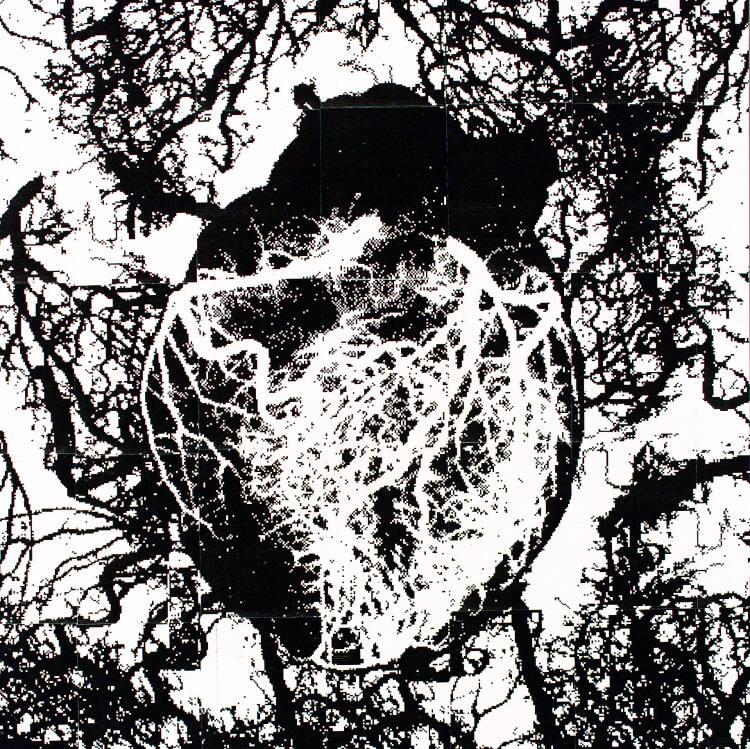
Heart - weiß
Peter Kogler
1989
Ab den 1980er-Jahren beginnt sich Peter Kogler, beeindruckt von Fernand Léger, dem seriellen Prinzip der Minimal Art, Filmarchitekturen des Expressionismus und utopischen Architekten wie Friedrich Kiesler, mit der Wirkmacht von Räumen zu beschäftigen.[1] Früh setzt er für die Motive seiner gedruckten repetitiven Mustersysteme den Computer ein und druckt diese per Siebdruck auf Papierbahnen und Tapeten. In seine Rauminstallationen werden nicht nur die Wände, sondern auch Boden und Decke einbezogen, was in Nachfolge der Op Art mit psychedelischen Effekten unsere Orientierung dekonstruiert und Schwindel und Schwanken auslösen kann. Koglers veränderte Bildcodes aus den Datenströmen sind Herzen, Gehirne, aber auch Ameisen und Röhren, die neben Tapeten auf Stoffplanen aus Kunstfaser mit Tintenstrahldrucker appliziert werden und zuweilen auch als Vorhänge, gekoppelt mit einer Videoprojektion, bewegte Kunsterfahrung vermitteln. Da die einfachen All-over-Zeichen den Gesichtskreis voll beanspruchen, eignen sie sich nicht nur für Theater und Film, sie machen Galerien, Museen, aber auch U-Bahnstationen wie in Wien jene am Karlsplatz oder die Bahnhofshalle in Graz zum Erlebnisparcours. Mit dem Ameisenmotiv in versetzt-verwinkelter Dreierreihe besetzte der Künstler Ausstellungsräume der „DOCUMENTA IX“ 1992 in Kassel; Catherine David ließ ihn dann die große Halle und Gänge der „documenta X“ 1997 mit verschlungenen Röhrenschlangen zum „coolen“ Seherlebnis erweitern.
Wie in den beiden Werken Heart ‒ rot und Heart ‒ weiß von 1989 und 1990 gut ersichtlich, bleiben die Siebdrucke mit Acryl auf Leinwand neben den labyrinthischen Raumerfahrungen auch der klassischen Kategorie Gemälde und damit dem Kunstmarkt erhalten, weshalb Robert Fleck Kogler nur mit Einschränkungen als reinen Medienkünstler gelten lässt.[2] Von den ersten Papierbändern mit Gehirnmotiven in den Clubräumen des Trabant in Wien und der Galerie Krinzinger in Innsbruck über die konzeptuelle Arbeit auf Plakaten mit „museum in progress“ 1992–2001 bis zu den Biennale- und „documenta“-Beiträgen bleibt Koglers Thema bis heute die Öffnung realer in virtuelle Räume ‒ und so läuft die Ameise wie der Geist des Menschen auf der Datenautobahn im Endlosfluss elektronischer Medien als leicht entzifferbares Kunstmotiv dahin.
The Essl Collection, hrsg. Klaus Albrecht Schröder und Elisabeth Dutz, Wien 2021, S. 126.
Impressed by Fernand Léger, the serial principle of Minimal Art, Expressionist film architecture, and utopian architects such as Friedrich Kiesler, Peter Kogler began to become preoccupied with the potency of spaces in the 1980s.[1] Early on, he used the computer for the motifs of his repetitive pattern systems and transferred these with a screen-printing process onto paper webs and wallpaper. His space-filling installations encompass both the walls and the floor and ceiling, which, in the wake of Op Art, deconstructs our orientation with psychedelic effects and may trigger dizziness and faltering. Kogler’s altered pictorial codes from data streams are hearts and brains, as well as ants and tubes, which are not only applied to wallpaper but also to fabric tarpaulins made of synthetic fiber with an inkjet printer or, occasionally coupled with video projections, confront us as curtains conveying a dynamic art experience. Taking up one’s entire field of vision, the simple all-over signs are not only suitable for theater and film but also turn galleries and museums, as well as subway stations, such as the one on Karlsplatz in Vienna or the concourse of the Graz Central Station, into a multisensory experience. With the ant motif in staggered rows of three, the artist occupied exhibition spaces at DOCUMENTA IX in Kassel in 1992; Catherine David then had him expand the large hall and corridors of documenta X in 1997 with intertwined, snake-like tubes to create a “cool” visual experience.
As can be clearly seen in the two works Heart – Red and Heart – White, the photocopies with acrylic on canvas not only retain the labyrinthine spatial experience but also adhere to the classic category of painting and thus maintain their place within the art market, which is why Robert Fleck considers Kogler a pure media artist only with reservations.[2] From the first paper bands with brain motifs in the Trabant club rooms in Vienna’s fourth district and the Krinzinger Gallery in Innsbruck to the conceptual work on posters with “museum in progress” (1992–2001) and his contributions to the Venice Biennale and the documenta exhibitions, Kogler has remained committed to the opening of real spaces into virtual spaces to this day—and thus the ant, like the human spirit, continues to run along the data highway in the endless flow of electronic media as an easily deciphered motif of art.
The Essl Collection, hrsg. Klaus Albrecht Schröder und Elisabeth Dutz, Vienna 2021, S. 126.


