
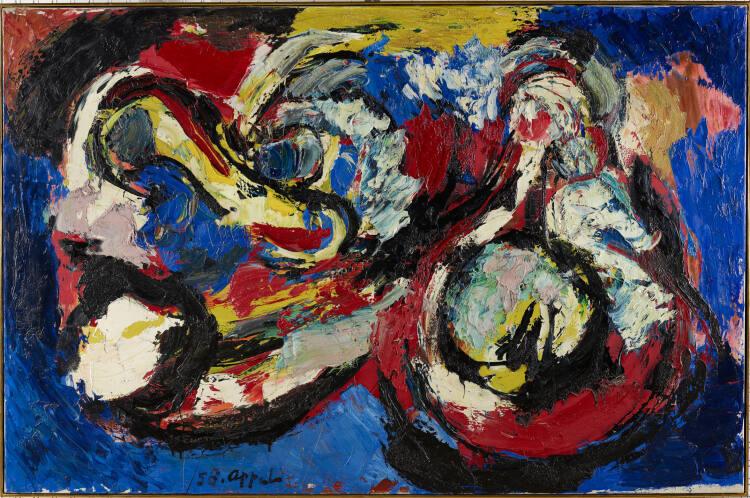
Die Hölle und ihre Freuden
Karel Appel
1958
Rahmenaußenmaß: 132 × 197,5 cm
An enormous dynamic of colors and forms determines the painting of Karel Appel. Pastose masses of paint collide with each other; garish and untamed, they dominate the pictorial space. Appel’s art bears witness to great gestural freedom, exuding an extraordinary intensity and vitality: “A painting is not a construction of colors and lines, but rather an animal, a night, a scream, a human being, or all of these together,” the artist explains. Painting as an organic entity. For Appel, it is the epitome of expressiveness and, in the spirit of the French ethnologist Claude Lévi-Strauss, reflects a wild thinking, la pensée sauvage. The artist’s ways of performative staging—his use of the body during the act of painting—are reminiscent of Pablo Picasso and Jackson Pollock. Spontaneity of experience and a determined immediacy of artistic expression characterize Appel’s painting, which covers countless canvases, found objects, walls, and streets. Abstraction dominates above all the early paintings of the Dutch co-founder of the artist group CoBrA, who, however, never completely abandoned the connection to representationalism. The painter, draftsman, and sculptor was committed to an experimental approach, exploring classical themes such as nudes, landscapes, and portraits and frequently changing his style to avoid falling into a routine. Important sources of inspiration are art autre, comics, and the art of children, indigenous peoples, and autodidacts.
“Painting is an exhilarating, sensual experience, influenced by the joy and tragedy of human life,” commented the globetrotter, who traveled the world intensively, maintained studios in, among other places, Paris, New York, Monaco, and Tuscany, was interested in the aggressiveness of the big city and Hell and Its Pleasures, and repeatedly painted crimes. Appel created works of existential dimensions, painted pictures based on real-life experiences. In his works, he strove to capture the mood of an era, to give validity to phenomena of a place, and to capture the spirit of the times. For his eyes were his memory, painting his third eye.
The Essl Collection, hrsg. Klaus Albrecht Schröder und Elisabeth Dutz, Vienna 2021, S. 34.
Eine enorme Dynamik der Farben und Formen bestimmt die Malerei von Karel Appel. Pastose Farbmassen prallen aufeinander, grell und ungebändigt beherrschen sie den Bildraum. Appels Kunst zeugt von einer großen gestischen Freiheit, verströmt eine außerordentliche Intensität und Vitalität: „Ein Gemälde ist nicht ein Bauwerk aus Farben und Linien, sondern ein Tier, eine Nacht, ein Schrei, ein Mensch oder dies alles zusammen“, meint der Künstler. Malerei als organisches Gebilde. Sie ist bei Appel der Inbegriff von Expressivität und spiegelt im Geist des französischen Ethnologen Claude Lévi-Strauss ein wildes Denken, la pensée sauvage, wider. Die performativen Inszenierungen des Künstlers, sein Einsatz des Körpers während des Malaktes erinnern an Pablo Picasso und Jackson Pollock. Spontaneität im Erleben und eine dezidierte Unmittelbarkeit im künstlerischen Ausdruck zeichnen Appels Malerei aus, die unzählige Leinwände, Fundstücke, Mauern und Straßen überzieht. Die Abstraktion beherrscht vor allem die frühen Gemälde des niederländischen Mitbegründers der Künstlergruppe CoBrA, der jedoch die Verbindung zur Gegenständlichkeit nie ganz aufgibt. Der Maler, Grafiker und Bildhauer verpflichtet sich einem experimentellen Zugang, erprobt klassische Themen wie Akte, Landschaften und Porträts, wechselt häufig den Stil, um in keine Routine zu verfallen. Wichtige Inspirationsquellen sind art autre, Comics, die Kunst von Kindern, indigenen Völkern und Autodidakten.
„Die Malerei ist eine ergreifende, sinnliche Erfahrung, von der Freude und der Tragik des menschlichen Lebens beeinflusst“, meint der Globetrotter, der die Welt intensiv bereist, u. a. in Paris, New York, Monaco und in der Toskana Ateliers hat, sich für die Aggressivität der Großstadt und Die Hölle und ihre Freuden interessiert, immer wieder Verbrechen malt. Appel schafft Arbeiten von existenziellem Ausmaß, malt Bilder, wie sie das Leben schreibt. Er will in seinen Werken die Stimmung einer Ära einfangen, Phänomenen eines Ortes Gültigkeit verleihen und den Zeitgeist festhalten. Denn seine Augen waren sein Gedächtnis, die Malerei sein drittes Auge.
The Essl Collection, hrsg. Klaus Albrecht Schröder und Elisabeth Dutz, Wien 2021, S. 34.
 IIIFPermalinkhttps://sammlungenonline.albertina.at/objects/427737/die-holle-und-ihre-freudenImage Request