
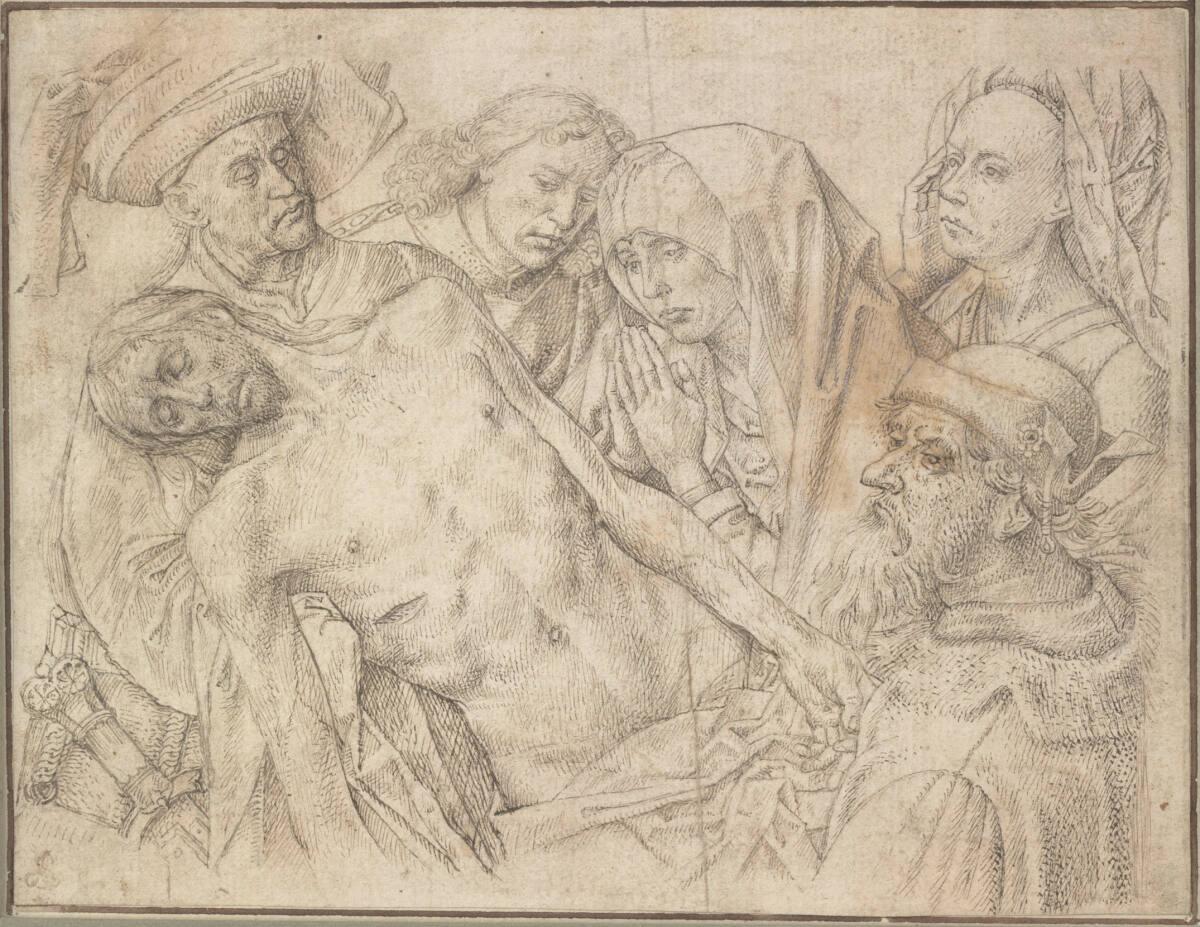

Die Beweinung Christi ("Große Kreuzabnahme")
Anonym
um 1500
Diese Federzeichnung überliefert uns eines der berühmtesten Gemälde der altniederländischen Malerei: die etwa 1475 bis 1477 geschaffene Beweinung des Hugo van der Goes (um 1440–1482), von der lediglich ein Fragment erhalten geblieben ist. Die Besonderheit der vielfach kopierten Komposition besteht darin, dass die Trauernden (von links: Joseph von Arimathia, Johannes, Maria, Nikodemus und Maria Magdalena) mit dem bildparallel aufgerichteten leblosen Körper Christi als Halbfiguren nahe an den Betrachter herangerückt sind, was dem Bild eine große Unmittelbarkeit und starke emotionale Wirkung verleiht.
Benesch (1928) bezeichnete das Blatt zu Recht als die getreueste Kopie nach Van der Goes’ Vorbild, da es den mehr als 30 bekannten Gemäldekopien in ausdrucksvoller Mimik sowie Detailtreue überlegen ist und daher wohl direkt vor dem Original ausgeführt wurde. Wie Sander (1992) betonte, gibt die Zeichnung auch die im Originalfragment durch spätere Übermalungen verunklärten Hände Mariens sowie den ursprünglichen Bildausschnitt mit den oben und seitlich angeschnittenen Figuren getreu wieder, während diese in den meisten anderen Kopien willkürlich vervollständigt wurden. Die Zeichnung stellt damit eine wesentliche Grundlage für die Rekonstruktion der goesschen Originalfassung dar.
Der für Blätter aus dem Umkreis und der Nachfolge des Hugo van der Goes typische Zeichenstil mit systematischen Kreuzschraffen und Punkten blieb in den Niederlanden lange gebräuchlich und wurde noch von Pieter Bruegel d. Ä. gegen die Mitte des 16. Jahrhunderts in ähnlicher Weise verwendet, was dazu führte, dass man ihm die qualitätvolle Zeichnung sogar fälschlich zugeordnet hat. Aufschlussreich sind die entlang der Figurenkonturen verlaufenden Griffelspuren, die wohl auf eine Stichreproduktion abzielten: Wie bereits Winkler (1964) erwog, stehen sie wahrscheinlich im Zusammenhang mit einem 1586 datierten Kupferstich von Hieronymus Wierix (Hollstein 382 /1), der mit der Wiener Zeichnung nahezu deckungsgleich ist.
This drawing reproduces one of the most famous
paintings of Early Netherlandish art: Hugo
van der Goes’s (c. 1400–1482) Lamentation or
Large Deposition, executed between 1475 and
1477. Van der Goes was probably born in 1440 in
Ghent. Nothing is known regarding his training.
He was regularly mentioned as a member of the
Ghent painters’ guild between 1467 and 1475.
Subsequently, he retired to the Augustinian priory
of Rood-Klooster, near Brussels, where he lived as a
privileged lay brother and continued to paint until
his death in 1482. Despite his brief, fifteen-year
creative period, Van der Goes is regarded as among
the leading Netherlandish masters, along with the
founding fathers Jan van Eyck (1390/99–1441) and
Rogier van der Weyden (1399/1400–1464). His works
were admired by his contemporaries and copied
well into the sixteenth century.
Lamentation is one of his best-known inventions
and the most frequently copied work of
Netherlandish art.1 A small tempera painting
on linen in Oxford, which was probably made
between 1475 and 1477, is regarded—not without
controversy—as the Van der Goes original. Only
a fragment of the work remains.2 The painting’s
composition is considered a further development
of Van der Weyden’s famous Descent from the Cross
(c. 1435/40)3 and of Giovanni Bellini’s (1431/36–1516)
celebrated depictions of the Pietà from between
1455 and 1470. Its distinctiveness resides in the fact
that the mourners, in half-figure (from left to right:
Joseph of Arimathea, Saint John the Evangelist,
Mary, Nicodemus, Mary Magdalene), along with the
supported, diagonally placed, lifeless body of Christ
after his deposition from the cross, are brought
close to the viewer. In this way, Van der Goes
created a new type of devotional image that reflects
profound human feelings by concentrating wholly
on the figures’ gestures and reactions.
Benesch rightly describes the Vienna drawing as
the most faithful copy of the Van der Goes model,
given its superiority over all other renditions in its
expressive gestures and attention to detail.4 Thus,
the sheet was very likely drawn directly from the
original. Gently hatched lines and pentimenti
demonstrate how the artist sought the proper
form and strove to capture the expression of the
figures, as well as their plasticity and materiality.
Christ’s bare upper body is modeled with particular
sensitivity. Furthermore, the draftsman
accurately reproduced the hands of Mary from
the fragmentary original, which were later effaced
by overpainting, as well as the original margins
with truncated figures. In other copies, however,
these details are inconsistently handled.5 As such,
the drawing is the essential link to Van der Goes’s
original. The systematic crosshatching and stippling
are typical of drawings by the circle and followers
of Van der Goes and long remained customary in
the Netherlands. It was still employed in a similar
manner by Pieter Bruegel the Elder (1526/27–1569)
in the mid-sixteenth century [74, 75], which led to
the present drawing being erroneously attributed to
him. The contours of the figures were later incised
in connection with an engraving executed in 1586
by Hieronymus Wierix (1553–1619),6 which is almost
congruent with the Albertina sheet.
The numerous copies and variations on the
composition served a growing collectors’ market.
In contrast to other Netherlandish masters of the
fifteenth century, Hugo van der Goes was never
forgotten in subsequent decades and centuries.
Indeed, the mental illness that overshadowed the
last two years of the artist’s life may have increased
interest in his oeuvre. Today, the drawing conveys
to us the most accurate rendering of Van der Goes’s
most popular painting, in which pain, sadness, and
emotional compassion are concentrated in a way
that is at once forceful, haunting, and timeless.
1. Stroo et al. 1999, 256–63, no. 12; Anne Dubois and Roel
Slachmuylders list around seventy copies (259). According to
Franziska May, more than one hundred copies exist; email to the
author, September 22, 2021. There is a forthcoming publication
planned for 2023: Stephan Kemperdick, ed., Hugo van der Goes,
exh. cat. (Berlin: Staatliche Museen Preußischer Kulturbesitz,
Gemäldegalerie).
2. Hugo van der Goes, The Virgin and Saint John (fragment
of The Lamentation of Christ), c. 1475–77, tempera on linen,
42 x 46.1 cm, Picture Gallery, Christ Church, University of
Oxford, JBS 231; Sander 1996, 156–71.
3. Rogier van der Weyden, Descent from the Cross, c. 1435/40,
oil on panel, 204.5 x 261.5 cm, Museo Nacional del Prado,
Madrid, P002825.
4. Benesch O. 1928, 4, no. 22.
5. Cf. Sander 1996, 165–67.
6. Winkler 1964, 128–29; Van Ruyven-Zeman and Leesberg
(NHD) 2004, part 2, 180, no. 382.1; copy of the engraving in the
Albertina Museum, DG66333, H/I/20/146.
Emily J. Peters, Laura M. Ritter (Hg.), AK Tales of the City. Drawing in the Netherlands from Bosch to Bruegel, Cleveland Museum of Art 9.10.2022 - 8.1.2023, New Haven 2022, Kat. Nr. 3
 IIIFPermalinkhttps://sammlungenonline.albertina.at/objects/28714/die-beweinung-christi-groe-kreuzabnahmeImage Request


