


Weibliches Bildnis
Peter Candid gen. Peter de Witte
vor 1570
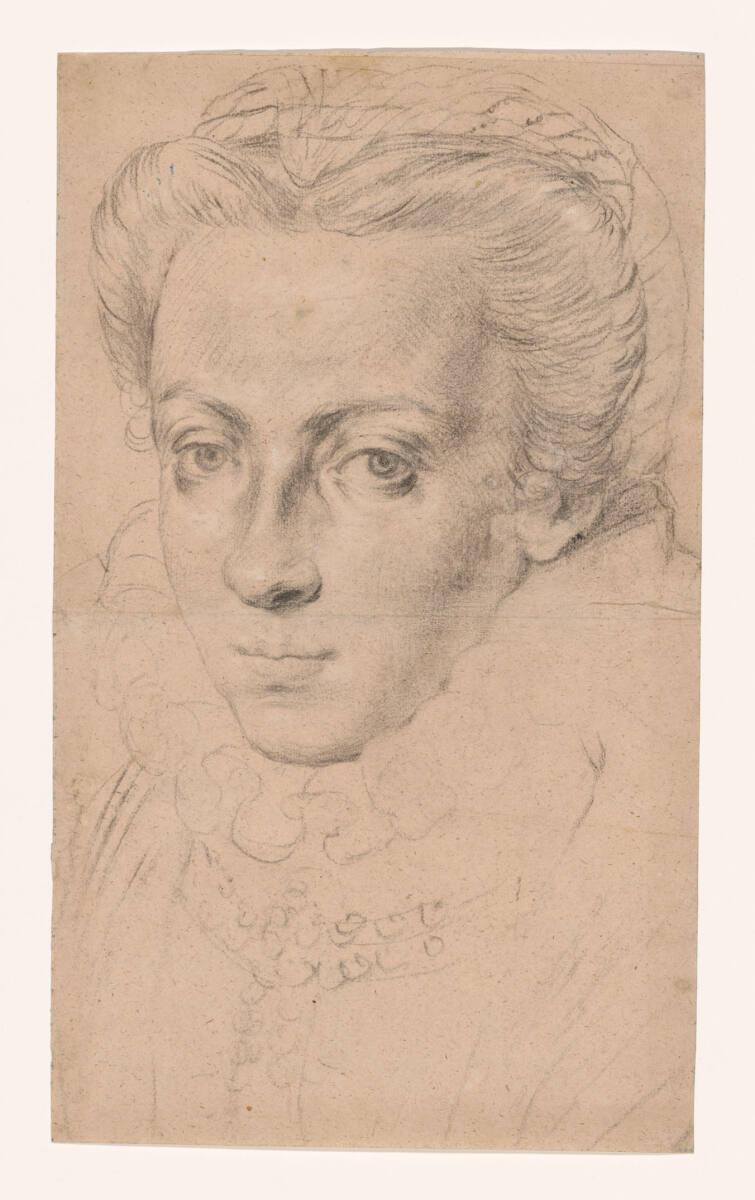
The lady in the present drawing is elegantly
dressed, her neck buried in a ruffled collar, her
bodice adorned with pearls. Her hair, parted in the
middle, is covered by a coif, of which a doublebraided
chain is visible, interwoven with pearls.
However noble her attire, the artist focused on the
sitter’s facial features: large eyes with prominent
lower eyelids, a slightly protruding nose, and a
small mouth with swelling lips.
Portrait painting was a lucrative field for sixteenthcentury
Netherlandish artists. Curiously, only a
small number of portrait studies from that period
are extant today. This is perhaps attributable to
painters’ tendency to design their works directly
on panel or canvas, possibly discarding any
preliminary drawings after the work was finished.
The present sheet, in life-size format and on coarse
paper, its refined physiognomy combined with a
sketchier rendering of costume, is most likely a rare
example of a study made in preparation for a painting.
A connection to a painted image is indeed suggested
by a recent discovery: when the drawing was
taken off its mount, contour lines matching those
of the recto, made with a reddish medium, were
revealed on the verso. Leaving some impression in
the paper, these lines probably resulted from tracing
the recto’s contours by placing the paper against
a source of transmitted light such as a window. In a
second step, these red lines could have been pressed
against a prepared surface to create an offprint,
serving as the starting point for a painting.
The drawing entered the Albertina’s collection
as part of an as-yet-unidentified album.1 The
Cahier of around 1820 claims it as by Anthonis Mor
(1516/21–1576/77),2 an attribution first refuted by
Friedländer.3 Benesch gave the drawing to Adriaen
Thomasz. Key (1545–1589), under whose name it was
kept until being rejected by Jonckheere.4 Though no
corpus of drawings by Key offers direct comparison,
it is unlikely that the courtly lady sat for an artist
who painted almost exclusively women of civic or
patrician background.
Meder was the first to suggest the sitter’s identity.5
The idea that the lady depicted is Anna of Austria
(1549–1580), fourth wife of Philip II of Spain (r.
1556–98), though rejected by Benesch, was received
positively by Popham and Jonckheere. Recently,
her identity was decidedly put forth by Gschwend,6
who not only pointed out the striking resemblance
to painted portraits of Anna7 but also the fact that
the sitter’s prominent coif was typical of Hapsburg
women.8 As drawn, Anna is without a veil, indicating
that her likeness was probably sketched in Vienna
or Prague in 1569–70, prior to her marriage to
Philip II.9 The paper’s watermark would support
that notion. As a possible author of the present
drawing, Gschwend suggests Peter de Witte I
(1546/50–1628), who is documented as having made
portraits of Anna in Vienna, as well as of her sister
Elisabeth and father, Emperor Maximilian II (r.
1564–76).10
Incidentally, Anna’s story intersects with the
theme of the present exhibition: she travelled to
Antwerp in 1570 before embarking to Spain to
meet her royal husband, a departure allegorized
in a drawing by Chrispijn van den Broeck
(1530–1590/91) [87].
1. According to Meder 1922, 11, “aus einem Klebeband der
Albertina.”
2. I am grateful to Laura M. Ritter and Sophie Rosenberger for
kindly procuring this information.
3. As reported by Benesch O. 1928, 19.
4. Benesch O. 1928, 19; Jonckheere 2007, 157.
5. Meder 1922, 11.
6. Annemarie Jordan Gschwend, Research Scholar, Centro
de Humanidades (CHAM), Zurich and Lisbon; her studies
on Hapsburg portraiture, including the present portrait,
will appear in Gschwend and Pereira 2022. I am grateful to
Gschwend for generously sharing her insights and for discussing
this drawing, giving me a preview of her research findings.
7. For instance, Alonso Sánchez Coello, Anna of Austria,
Queen of Spain, 1571, oil on panel, 176 x 98 cm, Kunsthistorisches
Museum, Vienna, 1733.
8. Part of the Spanish fashion, the coif was introduced to
the Vienna and Prague courts by Empress Maria of Austria
(1528–1603); information kindly shared by Annemarie Jordan
Gschwend, email to the author, August 21, 2021; see also
Bernis 1990, 100–108. This discussion will appear in Gschwend
and Pereira 2022 in the chapter “On Portraits and Portraitists at
Renaissance Habsburg Courts.”
9. Gschwend, email to the author, August 21, 2021.
10. Gschwend, email to the author, September 12, 2021.
Emily J. Peters, Laura M. Ritter (Hg.), AK Tales of the City. Drawing in the Netherlands from Bosch to Bruegel, Cleveland Museum of Art 9.10.2022 - 8.1.2023, New Haven 2022, Kat. Nr. 63


